

Incomplete spec packages create cost uncertainty, timeline delays and bids that can’t be compared side by side. A complete RFQ package with clear design conditions, code specifications, drawing details and documentation requirements helps fabricators deliver accurate quotes with reliable lead times.
A complete pressure vessel specification package includes a few essential components.
Define Your Design Conditions
Design conditions are the foundation of every pressure vessel RFQ. Three inputs are especially important because they help fabricators evaluate the rest of the RFQ details. Without them, fabricators may need to make assumptions or ask follow-up questions before they can evaluate wall thickness, material selection or weld joint efficiency.
Pressure and Maximum Allowable Working Pressure (MAWP)
Design pressure and MAWP are two distinct values, and both should be clearly identified in your RFQ package when available. Design pressure is the pressure value used to design the vessel for specified operating conditions. MAWP is the maximum allowable working pressure for the completed vessel under specified conditions, based on its design, materials, thickness and applicable code requirements.
American Society of Mechanical Engineers (ASME) Boiler and Pressure Vessel Code (BPVC) standards provide the technical framework for pressure vessel design, fabrication, inspection, testing and certification. To help fabricators prepare an accurate quote, include clearly labeled pressure requirements, including design pressure and MAWP when available. Design pressure is one key input that can influence material thickness, fabrication complexity and custom pressure vessel costs.
Operating Temperature Range
Specify both minimum and maximum operating temperatures. Temperature and pressure are key inputs that can influence wall thickness, material grade and fabrication requirements. ASME Section VIII references allowable stress values that vary by material and temperature.
Low-temperature service may require impact testing, depending on the material, thickness, minimum design metal temperature and applicable code requirements. High or low temperature service may also introduce additional requirements that affect material selection, testing or fabrication scope. If you provide only a nominal temperature, fabricators may need to ask clarifying questions or make assumptions that can delay quoting.
Material Specification and Process Media
The vessel’s process media plays a major role in material selection. Gas, steam, liquid chemicals, corrosive substances and oxygen service can each affect material grade, corrosion allowance and surface finish requirements.
If you have a preferred material, document the ASME material designation, such as SA-516-70 carbon steel or SA-240-316L stainless steel. If not, describe the process media so the fabricator can recommend an appropriate material grade for review.
Depending on the application, material options may include carbon and low alloy steels, stainless steel, duplex stainless steel, nickel alloys and aluminum. Material selection can affect custom vessel costs. Specify any required corrosion allowance, which accounts for expected material loss over the vessel’s service life.
Specify Code Compliance Requirements
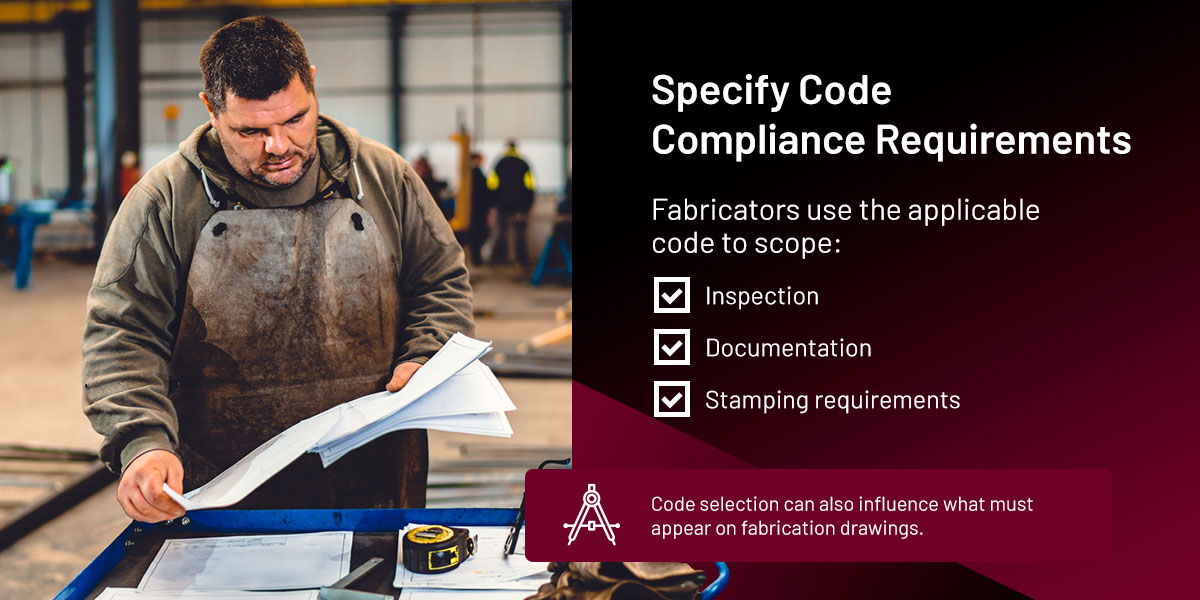
When code requirements are missing from RFQ packages, they can trigger clarifying questions or requotes. Fabricators use the applicable code to scope inspection, documentation and stamping requirements. Code selection can also influence what must appear on fabrication drawings.
Specify which code applies to your vessel. ASME Boiler and Pressure Vessel Code (BPVC) Section VIII, Division 1 is commonly used for many industrial pressure vessels in North America. ASME states that Section VIII, Division 1 includes requirements for pressure vessels operating at internal or external pressures exceeding 15 psig. Division 2 and Division 3 may apply to certain vessels with different design, analysis or pressure requirements.
Pressure vessels placed on the European Union (EU) market may need to comply with the Pressure Equipment Directive (PED) requirements and carry the CE marking, depending on the equipment and application.
Pressure equipment used in Canada may require Canadian Registration Number (CRN) registration through the applicable province or territory. Some participating jurisdictions may recognize design reviews conducted by other provinces or territories under mutual recognition agreements.
Prepare Your Drawing Package
Unclear or incomplete pressure vessel drawing requirements can cause manufacturability questions and delay quotes. However, complete drawings are not always necessary at the RFQ stage.
Provide Drawing Information or Design Input
While complete drawings help with quoting accuracy, many customers are uncertain about the vessel layout at the RFQ stage. Fabricators can support drawing development based on your requirements. The vessel layout will be designed in accordance with applicable code rules for the specified pressure and temperature ratings.
Fabricators typically provide the GA drawing for approval before proceeding with material purchases, to ensure you approve the design.
General Arrangement (GA) Drawing
A GA drawing provides the overall layout of the vessel. If you have an existing GA drawing, include it with your RFQ. If not, provide the key design inputs so the fabricator can develop one. Key elements often include:
Vessel tag number as a unique identifier for the vessel.
Orientation to specify whether the vessel is horizontal or vertical.
Support types such as skirt, saddle or legs.
Shell and head dimensions, including overall length.
Head type such as 2:1 ellipsoidal, hemispherical, torispherical or flat.
Design conditions with clearly labeled pressure and temperature.
Weights for both empty and operating conditions.
Nozzle Schedule
A detailed nozzle schedule should specify information for each connection, such as:
Nozzle tag such as N1, N2 or similar.
Nominal pipe size (NPS) for the connection diameter.
Pressure rating per ASME B16.5 class.
Face type such as raised face (RF), ring joint (RTJ) or flat face (FF).
Orientation angle from the vessel centerline.
Elevation from the tangent line or the datum.
Define Nondestructive Examination (NDE) Requirements
Common NDE methods can include radiographic testing (RT), ultrasonic testing (UT), liquid penetrant testing (PT) and magnetic particle testing (MT). Depending on the applicable code, insurance requirements or the buyer’s quality assurance (QA) program, the project may also require third-party or Authorized Inspector witnessing.
Omitting the NDE scope can lead fabricators to quote different examination levels or ask clarifying questions, which can make bids harder to compare. Depending on the project and fabricator, inspection and testing capabilities may include hydrostatic testing, radiography, helium leak testing, dimensional inspection, ferrite testing and impact testing.
Specify Documentation Requirements
Documentation requirements can become a scope gap when they are not defined up front. If buyers do not specify documentation needs early, missing requirements may not surface until later in the project. Documentation packages may be organized into tiers, such as:
Basic: GA drawing (as-built), ASME calculations.
Full: May include GA drawing (as-built), ASME calculations, material test reports (MTRs), test procedures and results, hydrostatic test report, NDE reports, weld maps and ASME Form U-1.
Note that engineering drawings and shop drawings are typically used during fabrication and are less likely to be included in the final documentation package. The GA drawing submitted for customer approval before material purchases will be updated to as-built conditions and included in the final package.
MTRs document material identity, chemical composition and mechanical properties. For code-stamped work, MTRs may need to be heat-number traceable. Missing or incomplete MTRs can be difficult to resolve after fabrication.
For ASME Section VIII, Division 1 code-stamped vessels, ASME Form U-1 serves as the manufacturer’s data report. Buyers should specify documentation needs in the RFQ to reduce scope gaps. Ask the fabricator which documentation package options are available for your project.
Working With Incomplete Specifications
Without a defined design pressure, operating temperature or material, your pressure vessel quote package may leave fabricators relying on assumptions or follow-up questions rather than complete engineering data. This can lead to delays, requotes or quotes that are difficult to compare accurately.
Some fabricators offer engineering support and may be able to help develop requirements when the initial input data is incomplete. Buyers can complete as much of the Vessel Quotation Checklist as possible, then work with the fabricator to identify and resolve remaining information gaps.
For quoting purposes, define the pressure vessel scope separately from any surrounding system requirements. Controls, external piping, instrumentation, installation details and broader system integration needs are typically outside the vessel package unless they are clearly documented in the RFQ. Clarifying these boundaries helps the fabricator quote the vessel itself accurately while identifying any items that should remain with the buyer or another project partner.
Send Your Pressure Vessel RFQ to BEPeterson
BEPeterson has provided custom pressure vessel fabrication support since 1935. We hold ISO 9001:2015 certification, along with pressure vessel-related certifications and registrations. Each project is assigned a dedicated project engineer who works with you to understand the application, review requirements and support the project from concept through delivery.
Whether you have a complete RFQ package or need engineering support to develop one, our team can help you identify the next step. Send your completed Vessel Quotation Checklist and RFQ package to sales@bepeterson.com, or call 508-501-0660 to discuss your pressure vessel requirements.