Choose Division 1 for a conservative, design‑by‑rule path with higher safety factors, thicker walls, predictable engineering hours and faster delivery on standard geometries at moderate pressures. Choose Division 2 when performance and efficiency matter: design‑by‑analysis (often FEA per Part 5), lower safety factor with higher allowable stress, thinner walls and weight/material savings—ideal for high pressure or temperature, cyclic service, complex nozzles or costly alloys. Expect tighter QA in Div. 2: expanded NDE, a PE‑certified Manufacturer’s Design Report and stricter material verification. Rule of thumb: Div. 1 fits most typical vessels; Div. 2 pays off when added engineering is outweighed by lifecycle or installation savings.
Choosing between ASME Section VIII Div. 1 and Div. 2 for your pressure vessel project directly impacts material costs, engineering timelines and long-term performance. Division 1 and Division 2 deliver code-compliant vessels, but they take fundamentally different approaches to design, analysis and quality control.
Division 1 offers a conservative, time-tested path using established formulas and higher safety margins. Division 2 allows for refined designs through rigorous analysis, enabling thinner walls and material savings in exchange for more demanding up-front engineering.
Understanding which standard aligns with your project’s pressure requirements, budget constraints and performance goals ensures you invest in the right solution from the start.
What Is ASME Section VIII Division 1?
ASME Section VIII Division 1 is the most widely adopted pressure vessel code in North America. This method relies on prescriptive formulas for typical vessel geometries, validated over decades of industry experience.
The Boiler and Pressure Vessel Code (BPVC) Section VIII Division 1 provides clear, straightforward guidance for standard applications. Key characteristics of this division standard include:
- Design-by-rule (DBR) approach: Provides established formulas for common vessel configurations, eliminating complex computational analysis and making Division 1 ideal for industrial applications where time-to-delivery and cost predictability are priorities. Engineers apply these formulas to cylinders, heads and nozzles without requiring advanced stress analysis.
- Higher design safety factor: Division 1 employs a higher design safety factor, resulting in thicker walls and heavier vessels.
- Preferred for moderate pressures: The go-to choice for vessels exceeding 15 psi in common industrial environments.
- Faster design-to-fabrication timeline: Prescriptive requirements and well-established formulas reduce engineering hours and accelerate project delivery.
What Is ASME Section VIII Division 2?
ASME Section VIII Division 2 takes a design-by-analysis (DBA) approach, allowing engineers to refine vessel designs through rigorous computational methods. Division 2 requires advanced analytical techniques — often including finite element analysis (FEA) — to validate that a vessel can withstand operating conditions without failure.
This standard uses a lower design safety factor, which permits higher allowable stresses. The result is reduced material thickness and lighter construction while still meeting stringent safety requirements. This engineering efficiency demands significantly more design effort, detailed material verification and rigorous design analysis to ensure structural integrity.
When evaluating pressure requirements, it’s important to understand that vessel design pressure and working pressure are not the same. Design pressure is the theoretical maximum pressure the system can withstand, as determined by the designer. Maximum allowable working pressure (MAWP) is the highest pressure the system can reach during operation and is set below the design pressure to provide a safety margin. Division 2’s analytical approach accounts for these distinctions with precision.
ASME Section 8 Div 2 explicitly verifies specific failure modes, including plastic collapse, local failure, buckling and fatigue, through detailed stress categorization and evaluation. This comprehensive approach positions Division 2 as the necessary choice for vessels operating under severe conditions, such as high pressure, high temperature, or cyclic loading, where weight reduction or material efficiency are critical business goals.
Key Differences When Comparing ASME BPVC Section VIII Standards
Understanding the core distinctions between ASME VIII-1 and VIII-2 helps you assess which standard delivers the best value for your specific application. The differences span design philosophy, material usage and quality assurance requirements.
Design Philosophy and Required Analysis
The DBR approach in Division 1 is conservative and less complex, making it faster to execute and easier to review. Engineers apply established formulas to standard geometries, and the built-in safety margins mean less time validating stress distributions. This simplicity accelerates project timelines and reduces up-front engineering costs.
The DBA approach in Division 2 requires specialized expertise and significant up-front investment. Engineers must perform detailed stress analysis, often using FEA, and strictly follow the rules outlined in Division 2, Part 5.
A common project error is applying FEA without adhering to the specific procedures Division 2 mandates, which invalidates the analysis and compromises code compliance. Because Division 2 explicitly accounts for failure modes such as fatigue and buckling, it can safely allow higher material stresses — but only when the analysis is performed correctly.
Material Usage and Costs
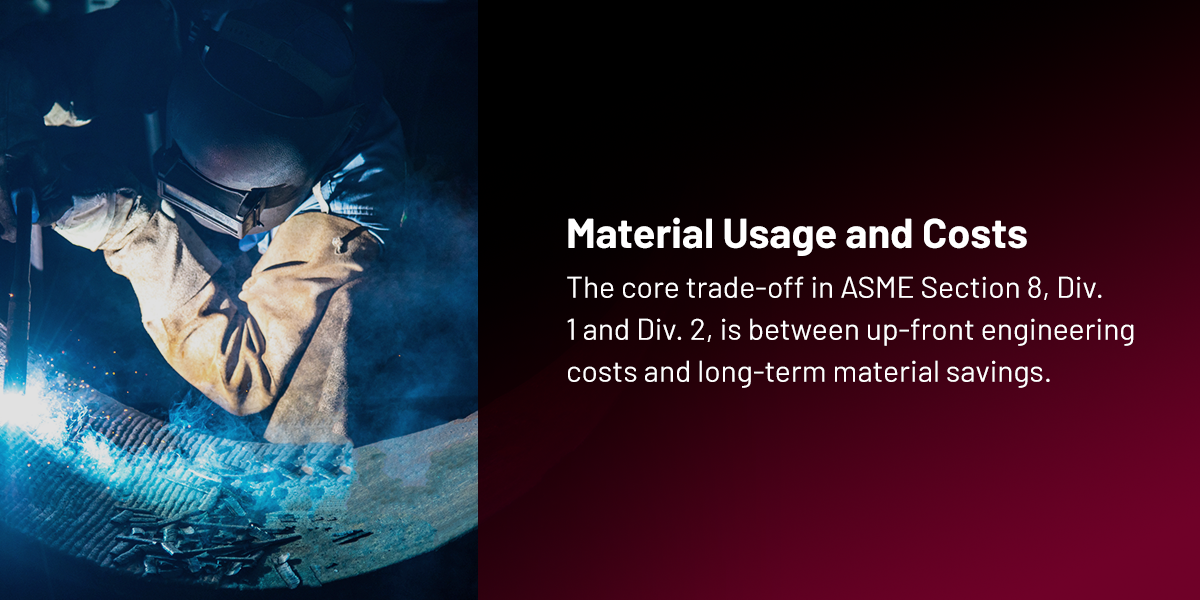
The core trade-off in ASME Section 8, Div. 1 and Div. 2, is between up-front engineering costs and long-term material savings. Division 1’s thicker walls and heavier vessels mean more material, more welding and higher fabrication costs. For smaller vessels or low-pressure applications, this added weight may not significantly impact the project budget.
Reduced wall dimensions in Division 2 can yield substantial material savings for large, heavy, or high-pressure vessels. For vessels that weigh several tons or operate at pressures above 3,000 psi, reducing wall thickness by even a fraction of an inch translates to meaningful cost reductions in steel, welding consumables and shipping. The savings often justify the more expensive and time-consuming up-front analysis, especially when weight reduction improves installation logistics or reduces structural support requirements.
Inspection and Certification
Division 2 imposes more stringent quality control and documentation standards than Division 1. Because Division 2 vessels operate at higher allowable stresses with reduced wall thickness, comprehensive quality assurance and safety inspections become critical to verify structural integrity. These enhanced requirements include:
- More extensive Nondestructive Examination (NDE): Fabricators must perform additional inspections to verify weld integrity and material properties throughout the vessel.
- Manufacturer’s Design Report (MDR): Every Division 2 vessel requires detailed documentation of the design basis, stress analysis and material selection.
- Registered Professional Engineer (PE) certification: The MDR must be certified by a PE, providing an additional layer of technical validation.
- Enhanced material verification: Material verification and inspection procedures are more rigorous to ensure the engineered design performs as calculated.
Choosing the Right Division for Your Project
Choosing between pressure vessel Div. 1 and Div. 2 depends on your project’s operating conditions, budget and performance priorities. The right standard balances compliance, cost and engineering effort to deliver the most effective solution.
When Is Division 1 the Right Choice?
Division 1 is the most practical and economical choice for the majority of pressure vessel applications. For many industrial uses, including storage tanks, heat exchangers and reactors, Division 1 provides code-compliant vessels without unnecessary complexity or expense. It meets standard pressure vessel codes while delivering proven reliability for projects where time-tested design approaches are sufficient.
Consider Division 1 when your project meets these criteria:
- Standard designs and common materials: Your vessel uses typical geometries (cylindrical shells, elliptical heads) and widely available materials like carbon steel or stainless steel.
- Moderate-pressure applications: Your vessel operates at a pressure lower than 3,000 psi.
- Lower up-front engineering cost is a priority: You want predictable engineering hours and faster turnaround from design to fabrication.
- Proven, time-tested reliability is sufficient: Your application doesn’t require material efficiency or weight reduction, and you value the simplicity of a well-established code.
When Is Division 2 the Right Choice?
Division 2 becomes the smart investment when your project demands performance-focused engineering or operates under conditions where Division 1’s conservatism isn’t cost-effective. Vessels operating above 3,000 psi or at elevated temperatures require material efficiency that directly impacts both feasibility and cost. Detailed stress analysis is necessary for complex geometries, large nozzles or unusual loadings that warrant rigorous evaluation.
Weight reduction often justifies the Division 2 approach. Lighter vessels reduce foundation costs, simplify installation and improve transportability for field-erected equipment. Expensive alloys and large-scale fabrication make reducing wall thickness financially advantageous, as material savings offset the higher engineering costs. These factors align when efficiency-driven performance drives the project requirements.
Trust BEPeterson for Your ASME Vessel Project
Whether your project calls for the straightforward reliability of Division 1 or the precision-engineered approach of Division 2, BEPeterson has the expertise to guide your decision and execute flawless fabrication. As a holder of the ASME single certification mark, we’ve delivered code-compliant pressure vessels since 1935.
Every project is assigned a dedicated engineer who ensures compliance, quality and clear communication from initial design through final hydrostatic testing. Our ISO 9001:2015-certified facility combines decades of engineering experience with rigorous quality assurance to deliver vessels that meet your exact specifications.
Call us today at 508-501-0660 or contact us at sales@bepeterson.com to discuss your pressure vessel requirements and receive expert guidance on the right ASME standard for your application.